[Book Review] The Software Engineer's Guidebook - A Book That Made Me Reflect on My Career
- A practical career guide based on 10 years as an engineer + 5 years as a manager
- Clearly explains responsibilities and expectations for each level from junior to Principal
- The importance of work journaling and promotion-driven development
- Team influence and the role of staff+ engineers as role models
- A book that even a 13-year veteran can relate to and learn from
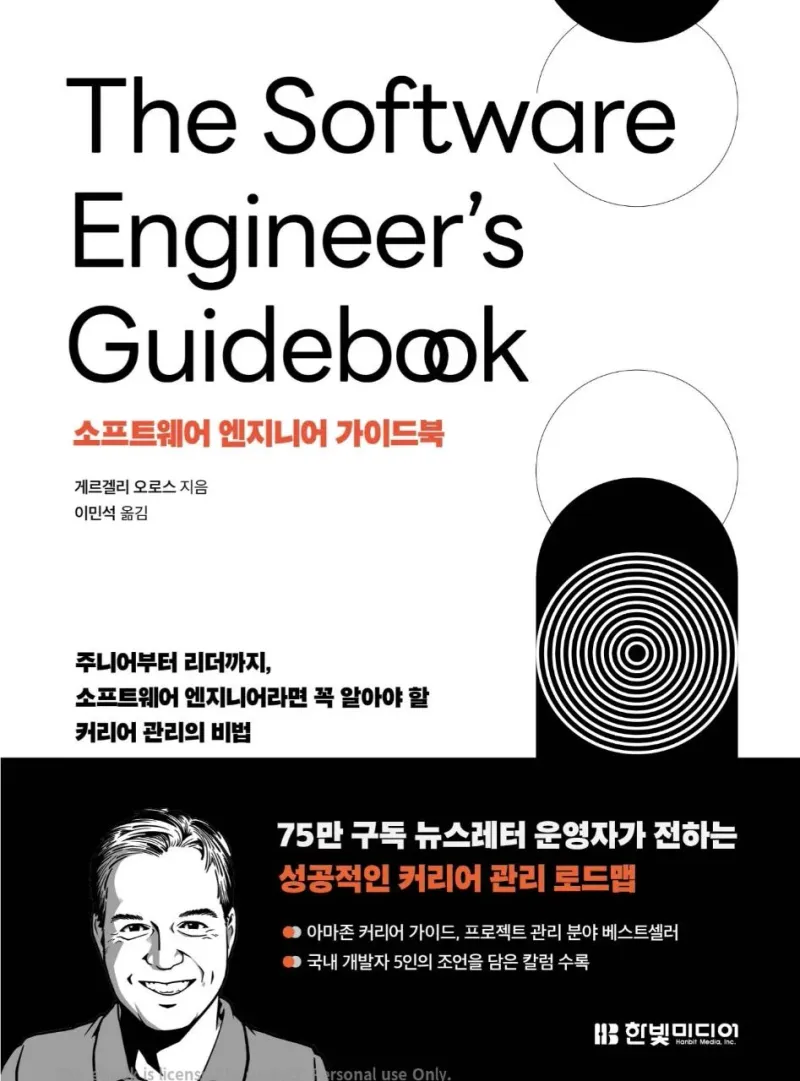
This book review is for The Software Engineer's Guidebook. I've been reviewing books provided by Hanbit for the past year, but this time I was inspired to read it after seeing a review post by Outsider. Since this is a light month, it's a self-funded review.
About the Author
The author, Gergely Orosz, is a software engineer and writer. He worked as an engineering manager and engineer at Uber, and previously as an engineer at Microsoft, Skype, Skyscanner, and JP Morgan. He currently runs The Pragmatic Engineer, the #1 tech newsletter on Substack with over 750,000 subscribers.
Based on 10 years of experience growing from junior developer to Principal Engineer, plus 5 years as an engineering manager, he compiled the career advice he wished he had received into this book. It took 4 years to write and became an Amazon #1 bestseller. The Korean edition was translated by Professor Lee Min-seok.

A Book for Developers Pondering Their Career
This book is for developers contemplating their career path. Developers face countless career environments—different teams, organizations, and levels, not to mention varying responsibilities depending on whether you work at a large corporation, mid-sized company, or startup. This book discusses what responsibilities and tasks are expected of you at each level across various environments.
The Importance of Work Journaling
One of the things repeatedly emphasized in the book is the importance of keeping a work journal. You need to record diligently so you don't forget when reporting to your manager, during retrospectives, or quarterly meetings to communicate your achievements. Without records, it's hard to accurately convey what you've done.

Promotion-Driven Development
I found the term "promotion-driven development" amusing—a parody of terms like TDD. Ultimately, you are responsible for your own career, not your manager or colleagues, so you must always be aware and prepared.
The Engineer Who Gets Things Done
In the sections on "the developer who gets things done" and "the engineer who gets things done," the book discusses Getting Things Done and its importance. Results come from outcomes, so it covers problems that arise in the process of creating them, solutions, how to course-correct, and appropriate responses to various situations you may face.
Team and Influence
As you advance in level, the focus shifts to teams and spreading influence. At this stage, completing your own work is a given—you're expected to influence those around you.
Staff and Principal Engineers as Role Models
One of the reasons I picked up this book was specifically for this section. After changing jobs, I was promoted to Principal Product Engineer, yet I had never given any thought to what this level meant. I read this book for reference.
Looking back at the past 3 months since the job change, have I done what befits a Principal? Not yet, I'm afraid. Still, I've learned a lot from it. If you're in a similar situation, I highly recommend reading it.

Special Features of the Korean Edition
At the end, there are special features exclusive to the Korean translation. It includes writings from Korean engineers, which I found quite interesting. There's also content about AI.
What this book ultimately conveys is one thing: We must never stop learning for our careers and must keep moving forward.
Closing Thoughts
With about 13 years of experience having worked at small, mid-sized, and large companies, this was a book that gave me much to think about. In some ways, it made me feel embarrassed for not having done as much as I should have, and in others, it made me feel like I'd done well. I think I'll discover new insights when I read it again later. It was a grateful and interesting book that made me think about my future career.
![[Book Review] Simplicity: Sustainable, Humane, and Effective Software Development](/_astro/minimalist-programmer-review-cover.Du1zuBcB.webp)
![[Book Review] Release It! - Design and Deploy Production-Ready Software for Large-Scale Distributed Systems](/_astro/release_it-01.CoDL4VuU.webp)
![[Book Review] Finding UX Through the Data Grind](/_astro/review-data-driven-ux-design-20250928143545540.Dxk-2c3e.webp)