[Book Review] Parenting in the AI Era
- Parents should help children develop the ability to ask questions and evaluate answers, rather than let AI do their thinking for them.
- The book covers practical AI parenting ideas alongside everyday concerns about children's futures and differences in parenting perspectives between spouses.
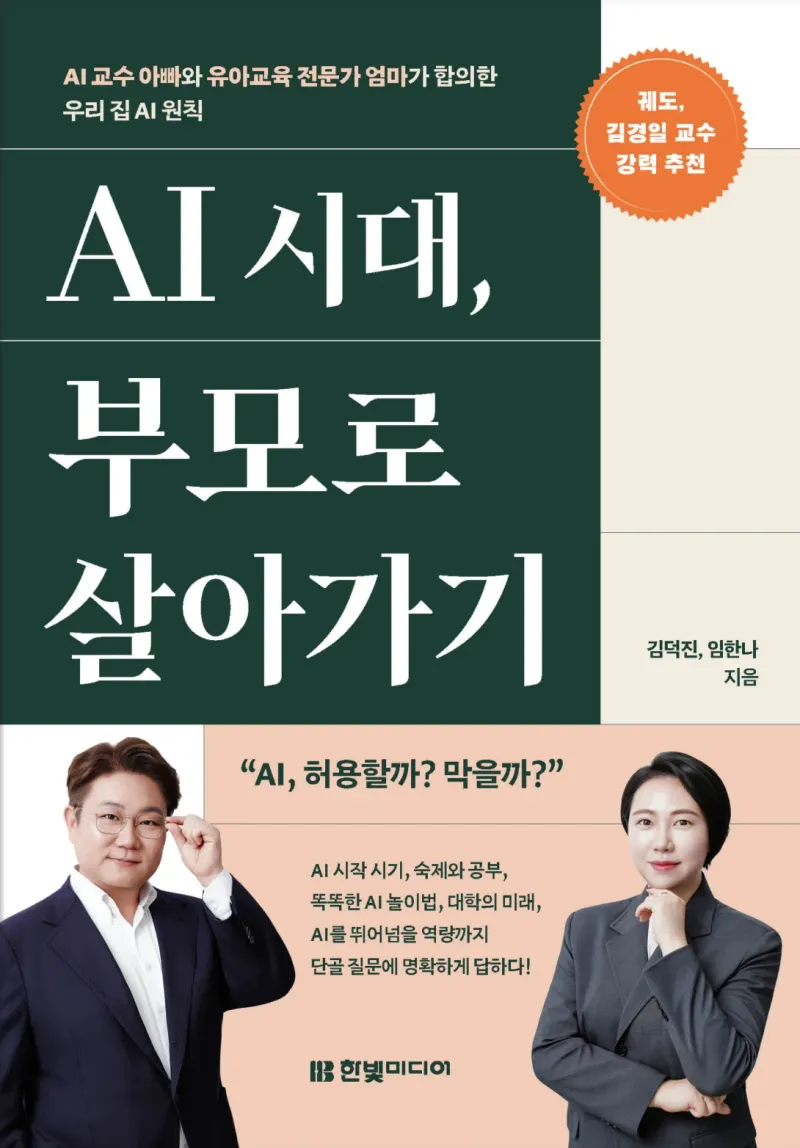
"This review was written as part of the Hanbit Media Reviewer Program, where I received a complimentary copy of the book."Introduction
I spent three years working on AI development at my previous company, and I still use AI quite a lot after changing jobs. But becoming the father of a two-year-old brought a new question to mind: how will AI affect parenting?
Published by Hanbit Media, AI 시대, 부모로 살아가기 (roughly, Parenting in the AI Era) answers this question through the perspectives of a married couple: a father who is an AI expert and a mother who specializes in early childhood education. The book is about how to introduce AI as a tool at home, rather than simply deciding whether to allow or ban it.
A Father's Experience Using AI in Parenting
I am raising my child abroad. We did not have access to a Korean postpartum care center, and the information available through our local community was limited. Cultural differences also made it difficult to apply Korean parenting advice directly. AI helped fill a lot of those gaps.
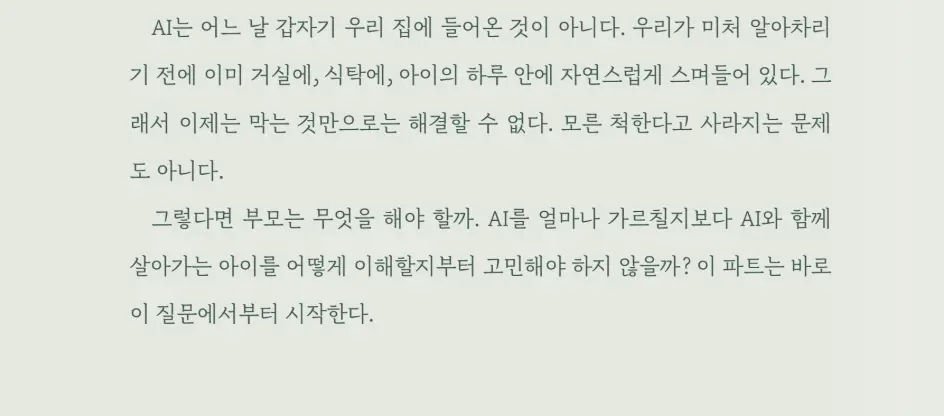
But a parent using AI and a child using AI directly are two very different things. Children will be exposed to far more AI in the future than they are today. If I am already concerned as the father of a two-year-old, I can only imagine how parents of elementary school children or teenagers must feel.
How Not to Outsource Thinking
The book's central message is that children should use AI to enrich their thinking, rather than hand their thinking over to it.
One approach it suggests is asking thoughtful, guiding questions. By asking the right questions, parents can help children recognize whether they actually need an answer right now and develop the ability to judge whether an AI-generated answer is true.
There is also a section on solving math problems. It describes a parent's role as protecting the time a child spends working through a problem, so that the child does not skip that process.
That really resonated with me. Time spent solving a problem is time spent thinking. Skip that time, and you may get an answer without taking anything away from the experience. I do not think this is only an issue for children, either. It feels like a habit everyone using AI today should develop.
Warnings About AI's Downsides
The book does not only talk about the benefits of AI. It also addresses darker aspects of digital life, including impulse control, the harmful effects of short-form videos, and a tendency it discusses among Gen Z to treat other people like NPCs. Before putting a tool into a child's hands, parents need to understand what it could harm.
It also offers ideas and practical tips for using AI in parenting.
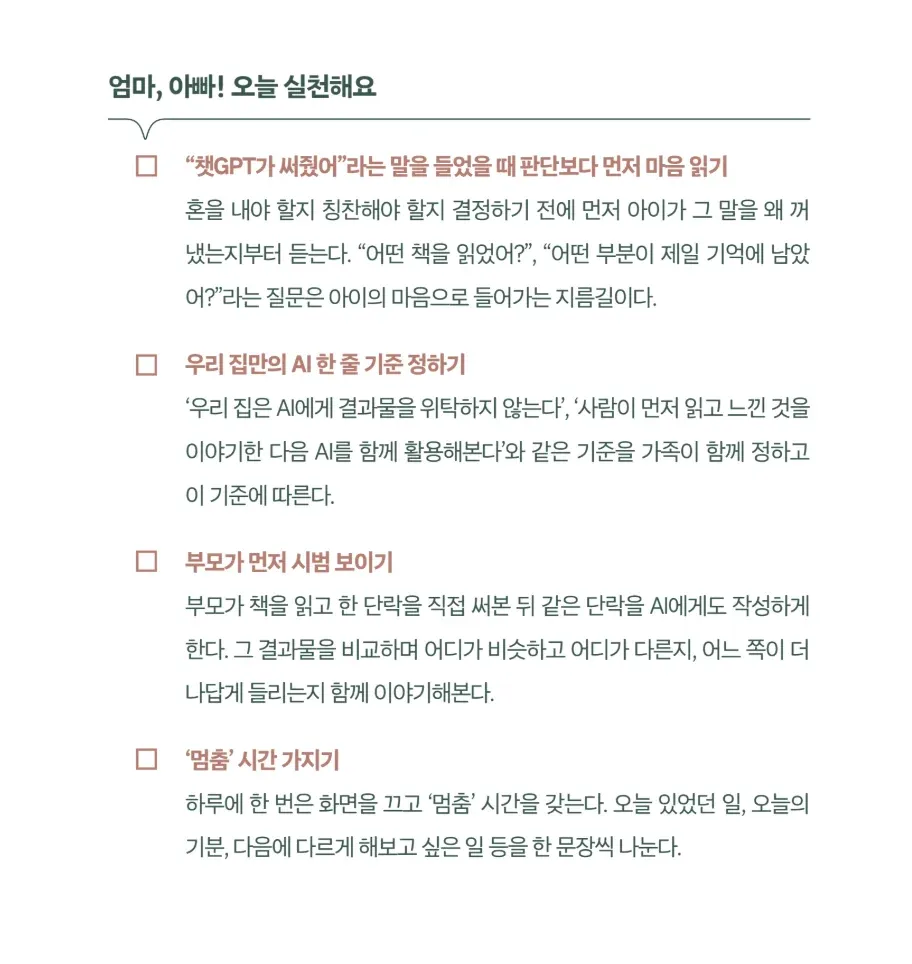
My favorite idea was to have AI take on the persona of a historical figure and let a child talk directly with that character. Being able to ask a historical figure questions could make studying history much more engaging.
Of course, the AI is only playing a character, not the actual person, and its answers may contain inaccuracies. The book emphasizes that parents should stay involved and check the information together with their children. This could also be a useful way to practice the ability to judge whether something is true.
Parenting Concerns Beyond AI
Since the book is written for parents, it goes beyond AI itself. It explores practical questions such as how our children will earn a living in the future and whether university will still be necessary. It also offers useful tips, including helping children develop a sense of money by earning some themselves at a young age.
Bridging Differences Between Spouses
Raising a child is not something you do alone. People have different personalities, and spouses inevitably have different views on education. As a couple, you might be able to work those differences out between yourselves. But once a child is involved, things become more complicated. When parents apply different standards, the child is the one left confused.
Using differences in views on learning with AI as an example, the authors show how they worked through this conflict themselves. The combination of an AI professor father and an emotional intelligence educator mother made their experience feel especially grounded.

Closing Thoughts
Before reading this book, I did not even know about restrictions on children under 14 using services like ChatGPT. It simply had not been on my radar. Even though I build and use AI every day, there was still a lot I did not know from a child's perspective.
After finishing it, I found myself thinking that although this is a book about children, it might be even more useful for people who are not yet comfortable with AI, such as my parents or my spouse. It works well as an introduction that helps readers develop a clearer sense of how to approach AI.
References
- Kim Deok-jin and Lim Han-na, AI 시대, 부모로 살아가기 (Korean; title translated here as Parenting in the AI Era), Hanbit Media
![[Book Review] Visualizing Generative AI](/_astro/review-visualizing-generative-ai-cover.BA0TjpHs.webp)
![[Book Review] Hiring an AI Lawyer for $20 a Month with ChatGPT](/_astro/review-ai-lawyer-with-chatgpt-20240820230216439.DNdPkuc5.webp)
![[Book Review] AI Truth](/_astro/review-ai-truth-20240915184625237.C5vegJrL.webp)