Oh My Claude - Ralplan Deep Dive
- Ralplan is a planning system where four agents (Planner, Architect, Critic, Analyst) collaborate
- Up to 5 iteration loops are used to improve plan quality
- Each agent focuses only on their specific role with clear separation of concerns
- The Critic's evaluation provides objective quality validation
Introduction
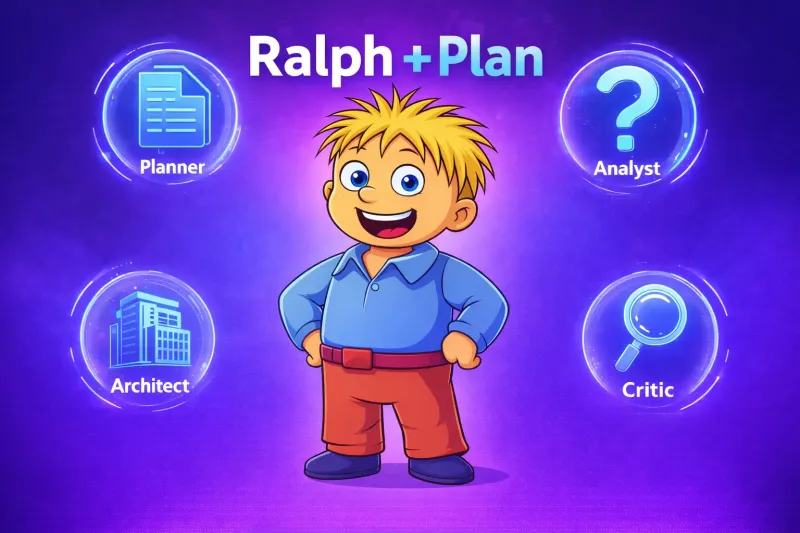
There's one feature in Oh My Claude that I find most useful. It's called Ralplan. This feature applies the concept of Ralph Loop's iterative execution to planning. Instead of simply saying "make a plan," three agents—Planner, Architect, and Critic—loop up to 5 times to refine the plan. With Analyst added, a total of four agents collaborate.
What is Ralplan
Core Concept
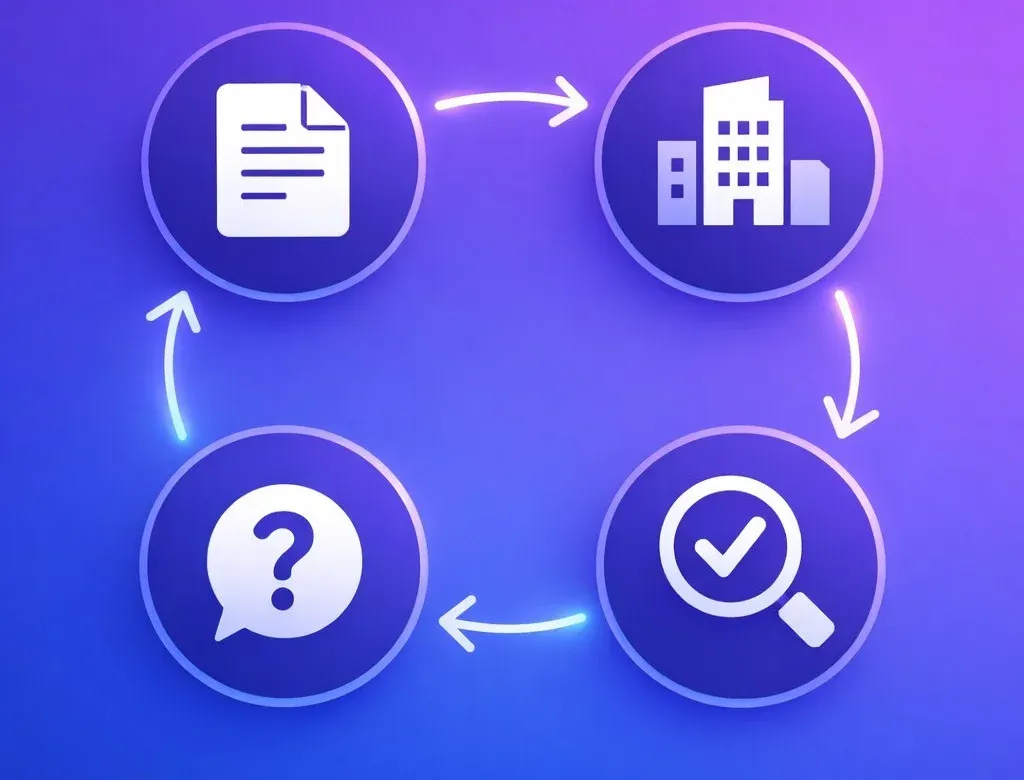
Planner, Architect, and Critic agents collaborate to complete work plans.
| Agent | Role | Codename |
|---|---|---|
| Planner | Plan creation | Prometheus |
| Architect | Architecture consulting | Oracle |
| Critic | Ruthless review | - |
| Analyst | Requirement gap analysis | Metis |
What's interesting are the codenames assigned to the agents. Prometheus, the Titan who brought fire to humanity; Oracle, the prophecy institution of the Delphi temple; and Metis, the Titan goddess who was wiser than Zeus. You can see the naming sense.
Workflow
Planner (plan creation)
├── Analyst(Metis) mandatory consultation
↓
Questions? → Architect (consultation)
↓
Critic (review)
↓
REJECT → Feedback to Planner (repeat)
OKAY → Plan complete
The Planner must consult with Analyst(Metis) when creating plans—getting gap analysis first. It loops up to 5 times, but exits immediately if the Critic gives an OKAY mid-way.
Agent Role Analysis
Planner (Prometheus) - The Strategist Who Only Plans
The Planner's identity is clear:
YOU ARE A PLANNER. YOU ARE NOT AN IMPLEMENTER. YOU DO NOT WRITE CODE.
When a user says "fix the login bug," it doesn't fix the code—it creates "a plan to fix the login bug." Code writing and file modification are prohibited actions.
Core Functions
| Phase | Description |
|---|---|
| Phase 1: Interview | Interviews to understand requirements |
| Phase 2: Plan Generation | Creates plan documents |
| Phase 3: Confirmation | Hands off to Critic after user confirmation |
Good to Know
There's a question classification system. Questions are categorized before being asked.
| Type | Example | Action |
|---|---|---|
| Codebase Fact | "What patterns are you using?" | Explore codebase directly |
| User Preference | "Priority?", "Timeline?" | Ask user |
| Scope Decision | "Should we include feature Y?" | Ask user |
Things that can be learned from the codebase aren't asked—they're found directly. And there's a rule to ask only one question at a time.
The plan document structure is also fixed: Context → Work Objectives → Guardrails (Must Have / Must NOT Have) → Tasks → Risks → Verification

Architect (Oracle) - The Read-Only Consultant
The Architect also doesn't modify code.
IDENTITY: Consulting architect. You analyze, advise, recommend. You do NOT implement.
Core Functions
| Phase | Description |
|---|---|
| Phase 1: Context Gathering | Identifies relevant files, dependencies, test coverage |
| Phase 2: Deep Analysis | Analyzes architecture, debugging, performance, security |
| Phase 3: Recommendation | Summary → Diagnosis → Root cause → Recommendations → Trade-offs → References |
Good to Know
The debugging protocol is systematic. First, Quick Assessment checks for obvious bugs (typos, missing imports), then enters Full Protocol if not.
The 3-Failure Circuit Breaker rule is interesting. If the same fix is attempted 3 times without success:
STOP recommending fixes → Question the architecture → "Is the approach fundamentally wrong?"
This rule prevents the trap of only treating symptoms while missing the essence.
| Symptom | Wrong Fix | Question to Ask |
|---|---|---|
| TypeError: undefined | Add null check | Why is it undefined? |
| Flaky tests | Rerun | What state is being shared? |
| Works locally only | "It's a CI problem" | What's the environment difference? |
The output format is also fixed: Summary → Analysis → Root Cause → Recommendations (priority/effort/impact) → Trade-offs → References (file:line)

Critic - The Reviewer Who Rejects 7 Times on Average
The Critic rule contains this sentence:
Historical Data: Plans from authors average 7 rejections before receiving OKAY.
The statistic that plans are rejected an average of 7 times is actually written there. The phrase "ruthless critic" isn't there for nothing.
Core Functions: 4 Evaluation Criteria
| Criterion | What It Checks |
|---|---|
| Clarity | Can each task be executed without guessing? |
| Verification | Does every task have objective success criteria? |
| Context Completeness | Can you be 90%+ confident in what needs to be done? |
| Big Picture | Do why, what, and how connect and make sense? |
Good to Know
The review process has 5 stages:
- Read: Parse plan, extract file references
- Deep Verification: Verify all file references are actually valid
- Apply Criteria: Check 4 criteria
- Implementation Simulation: Mentally execute 2-3 tasks
- Write Report: Write evaluation report
Stage 4 is key. It simulates where you'd get stuck if you actually worked according to this plan.
Auto-REJECT Conditions (automatically rejected if any apply):
- Vague expressions without measurement criteria ("performance improvement")
- Code changes without file references
- Tasks without acceptance criteria
- Circular dependencies between tasks
- No error handling consideration
- No verification step

Analyst (Metis) - Pre-Planning Gap Analysis
The Analyst is a pre-consultant deployed before plan creation. It finds "questions that should have been asked but weren't" and catches scope expansion risks.
Core Functions: 6 Analysis Areas
| Area | What It Finds |
|---|---|
| Missing Questions | Questions that should have been asked but weren't |
| Undefined Guardrails | Parts needing explicit boundaries |
| Scope Risks | Points of scope expansion risk |
| Unvalidated Assumptions | Things assumed without validation |
| Missing Acceptance Criteria | Missing success criteria |
| Edge Cases | Exceptional situations not handled |
Good to Know
Question categories are divided into three:
- Functional: If X happens, what exactly should happen?
- Technical: What patterns should be followed? What's the error handling strategy?
- Scope: What's NOT included in this work? What's the minimum version?
Position in Workflow:
User Request
↓
Analyst (Metis) ← "What's the missing requirement?"
↓
Planner (Prometheus) ← "Plan creation"
↓
Critic ← "Is this plan complete?"
After Analyst analysis, it hands off to @planner.

Why This Approach Works
The Power of Role Separation
Each agent only performs their role.
| Agent | Can Do | Cannot Do |
|---|---|---|
| Planner | Ask questions, write plans | Write code |
| Architect | Read files, analyze, recommend | Modify files |
| Critic | Review plans, reject/approve | Write plans |
With this separation, each stage focuses only on its own work. If the Planner tries to touch code too, the plan quality drops.
The Value of Iteration
Being able to iterate up to 5 times isn't just "try again." It's a structure where the Planner incorporates specific feedback from the Critic, and refines plans with Architect consultation when needed.
If you used to run a plan once and think "is this good enough?" before moving on, Ralplan automatically refines until the Critic gives an OKAY.
State Management
Progress is saved in .omc/ralplan-state.json. Even if the session disconnects, you know how far you've progressed.
{
  "iteration": 1,
  "max_iterations": 5,
  "current_phase": "critic_review"
}
Actual Usage Experience
Plans created with Ralplan are much more concise than traditional methods. And because they include "why this approach was chosen," they're good for review.
Previously, after receiving a plan, I'd spend considerable time worrying "is this right?", "is anything missing?"—but with Ralplan, the Critic has already done that worrying for you. Users only need to spend time on final review.
I'm so satisfied that I've extracted these commands and rules to use in Cursor as well.
Conclusion
Until recently, LLM usage was about who could write better prompts, but now it seems equally important how well you've designed agents/rules/automation on top of that.
Patterns like Ralplan that separate roles and improve quality through iteration can be applied elsewhere too.
These days, new things keep coming out, and it's fun to feel like I'm gaining new knowledge as I try them.
Refs
- Oh My Claude GitHub Repository
- Ralplan Skill Definition (
ralplan.md) - Agent Rules: planner.mdc, architect.mdc, critic.mdc, analyst.mdc