[Book Review] Korea's KOSPI at a Glance
- The book explains the structural causes of the Korea discount and how the Korean stock market may be changing.
- It maps the Korean economy through three engines: AI, infrastructure and energy, and exports and K-Everything.
- The book is even more interesting when read in the context of the intense optimism about the KOSPI reaching 10,000 when it was written.
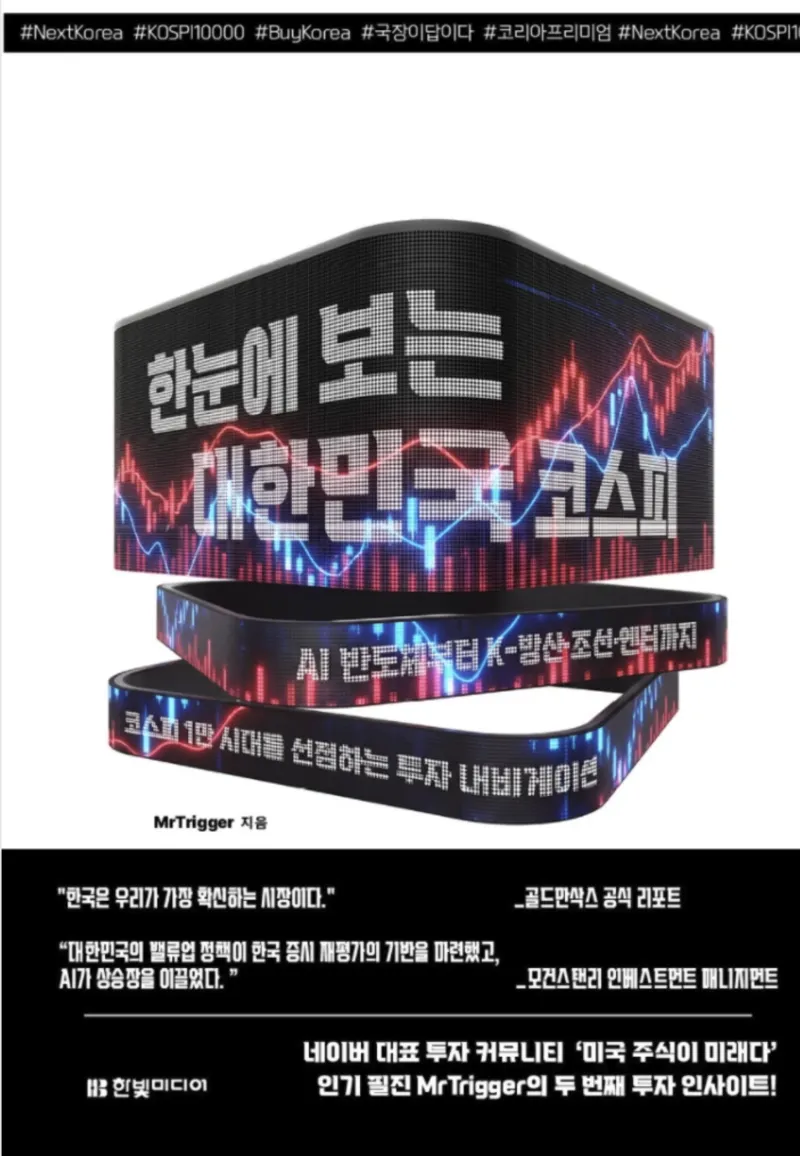
import discountStructureImage from '../../../assets/review-overview-of-korea-kospi-02.webp'; import corporateSplitImage from '../../../assets/review-overview-of-korea-kospi-01.webp'; import hlMandoImage from '../../../assets/review-overview-of-korea-kospi-03.webp';
[Book Review] Korea's KOSPI at a Glance
"This review was written with a complimentary copy provided through Hanbit Media's <I Am a Reviewer> program."The Korean Stock Market Through the Eyes of an Outsider
This book was published on June 30, 2026. It includes very recent information, and because it was written by the same author as The AI Semiconductor Industry at a Glance, it sometimes feels like a sequel. The previous book focused on the semiconductor industry, while this one turns its attention to Korea's domestic stock market.
After moving to Canada, I began investing mainly in the U.S. and broader North American markets. As a result, I mostly encountered the KOSPI through news headlines. I knew the phrase "Korea discount," for example, but I could not clearly explain the structures behind it. This book begins at exactly that point.
The Korea Discount and the Canary in the Coal Mine
Chapter 1 opens by examining the history and structural weaknesses of Korea's domestic market. It discusses a system in which profits are not always returned to shareholders and explains why the KOSPI is often compared to a canary in the coal mine. Yet the book does not end with pessimism. It also highlights how these problems are gradually changing and presents the author's thoughts on the possibility of the KOSPI reaching 10,000.
<Image src={discountStructureImage} alt="Diagram showing how circular shareholding, tunneling, and related-party transactions deepen the Korea discount" />
The book's comparison of spin-offs and carve-outs also helps explain the corporate-governance issues embedded in the Korean stock market.
<Image src={corporateSplitImage} alt="Diagram comparing how spin-offs and carve-outs affect controlling-shareholder power and the value held by existing shareholders" />
Why an Exchange Rate of 1,500 Won per Dollar Is Different from the IMF Crisis
This was the most interesting chapter for me. It carefully compares today's exchange rate near 1,500 won per U.S. dollar with the conditions during the Asian financial crisis, helping organize concerns that can otherwise feel vague when looking only at the number. Many people naturally recall the anxiety surrounding the last time the exchange rate reached this level, but the book argues that the foundations of the economy are now completely different and that excessive fear is unnecessary. It also covers how both domestic and overseas investors view the Korean market.
The Three Engines Driving the KOSPI
While Chapter 1 covers the KOSPI's history and how the market reached its current position, Chapter 2 explains today's Korean economy through three pillars: AI, infrastructure and energy, and exports and K-Everything. It begins with the history of each pillar and then shows where individual companies fit. It gradually builds a picture of how familiar large companies, less visible companies with essential technologies, and the businesses supporting each sector are connected.
<Image src={hlMandoImage} alt="Diagram showing how HL Mando's automotive steering and braking actuator technologies transfer to robotic joint technologies" />
This is not a book only about Samsung Electronics and SK hynix. It repeatedly demonstrates how numerous sectors connect with one another, which gave me the same enjoyment I found in the author's previous book. Rather than focusing on individual stocks, it helps readers understand the broader industrial structure.
A Book Written Amid the KOSPI 10,000 Fever
There is one ironic aspect to this book. It was written and published when many people were excited by the possibility of the KOSPI reaching 10,000. It was a moment when patriotic enthusiasm about the Korean market was near its peak. Reading it again at the end of July 2026 makes many passages even more interesting. The author probably did not expect the upward trend to move this quickly either. It is a giant dopamine-driven market whose next sudden rise or fall is impossible to predict.
Closing Thoughts
Even with that present-day irony in mind, the book fulfills its role as an introduction to the structure of Korea's domestic stock market. This is especially true for readers like me who begin with little knowledge of the market. I appreciated how it offered both energy about the market's potential to develop further and the knowledge supporting that optimism. Still, the book becomes more interesting when you remember that it was written at the height of the KOSPI 10,000 fever.
![[Book Review] The Software Engineer's Guidebook - A Book That Made Me Reflect on My Career](/_astro/software-engineer-guidebook-review-cover-20250217150000.Cr8TcTjm.webp)
![[Book Review] AI Semiconductor Industry at a Glance](/_astro/history-of-the-ai-era-through-semiconductors-cover.59KlrCDp.webp)
![[Book Review] Finding UX Through the Data Grind](/_astro/review-data-driven-ux-design-20250928143545540.Dxk-2c3e.webp)