The Era of Sharing PRDs Made with Prompts
- A practical share-out of a PRD created with prompts and how it holds up in real planning.
- Clarifies what parts of product documentation can be automated and where human judgment must stay.

I recently added a Related Articles feature to this blog. (You can see it if you scroll down.)
The feature itself is quite simple. During the build process, each article is embedded and stored in Neon Postgres, with a hash check to skip duplicates. Only changed or new articles get added. Then it fetches Related Articles through similarity search and adds them to the static pages via Astro.
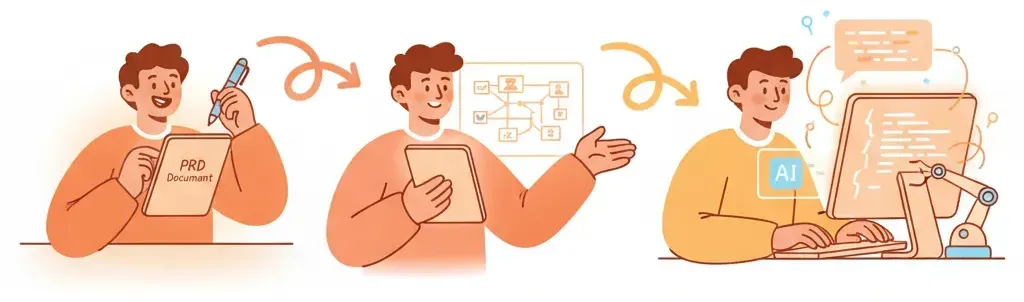
Before the actual implementation, it took about 15 minutes to create the development document with AI. I had already organized the approach in my head, so writing it up was quick. Implementation and testing took another 15 minutes. The whole thing was done in 30 minutes.
I shared this feature with my friend Evan.
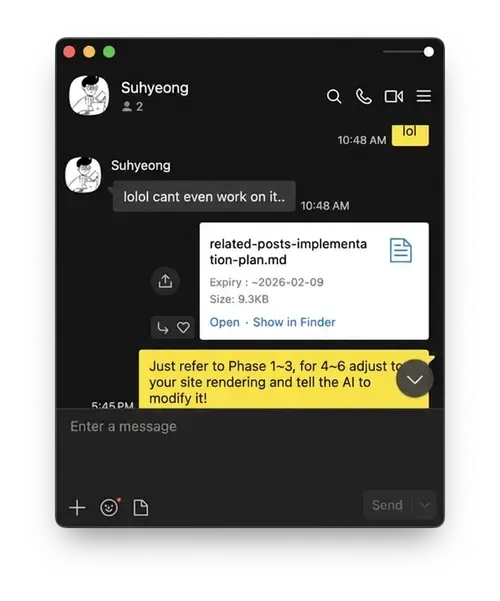
Trying it out, I noticed a few advantages. Since AI-written PRD/implementation docs already have everything explained, there's no need for lengthy explanations. The recipient can also take the document, adapt it to their own environment with AI, and apply it right away.
The next day, on my way to work, I recalled a tweet by Ryan Dahl (creator of Node.js, co-founder of Deno) that I'd seen a few days earlier.
"This has been said a thousand times before, but allow me to add my own voice: the era of humans writing code is over. Disturbing for those of us who identify as SWEs, but no less true. That's not to say SWEs don't have work to do, but writing syntax directly is not it." — Ryan Dahl
It's not that SWEs have nothing to do—it's that directly writing syntax is no longer the core of the job.
I felt that deeply. It's not just code writing that has changed—it's how we hand off work entirely. Coding, demos, prototypes, documentation—things we used to do ourselves can now be handled through writing, or rather, through prompts. I'm using this approach not only for personal projects but at work too.
Wrapping Up
Opus 4.5 in particular has been a game changer. I try every new model that comes out, but for coding, I still can't quite get used to the others. Whether it's a prompting issue or not, after trying Gemini 3 Pro, Codex 5.2 Max, and others, I always end up coming back to Opus 4.5.
Recently, I've been creating and using Skills with OpenClaw (formerly Clawdbot, Moltbot). Sharing these skills makes it easy to pass along even complex AI workflows. I'll be posting a OpenClaw review soon.
I'm both excited and a little scared to see where this all goes.

![[Book Review] AI Vibe Coding Guide for Today's Teachers with the 2022 Revised Curriculum](/_astro/review-ai-vibe-coding-guide-with-2022-revised-curriculum-cover.BWxr1kAp.webp)